
Seamless Gutters in Orlando, FL
A seamless gutter isn't cut from a shelf stack — it's formed to the exact length of your roofline, in your driveway, the day we install it. That single unbroken run is what keeps a hard Orlando downpour from finding the one joint that always seems to fail first.
Call (689) 400-8133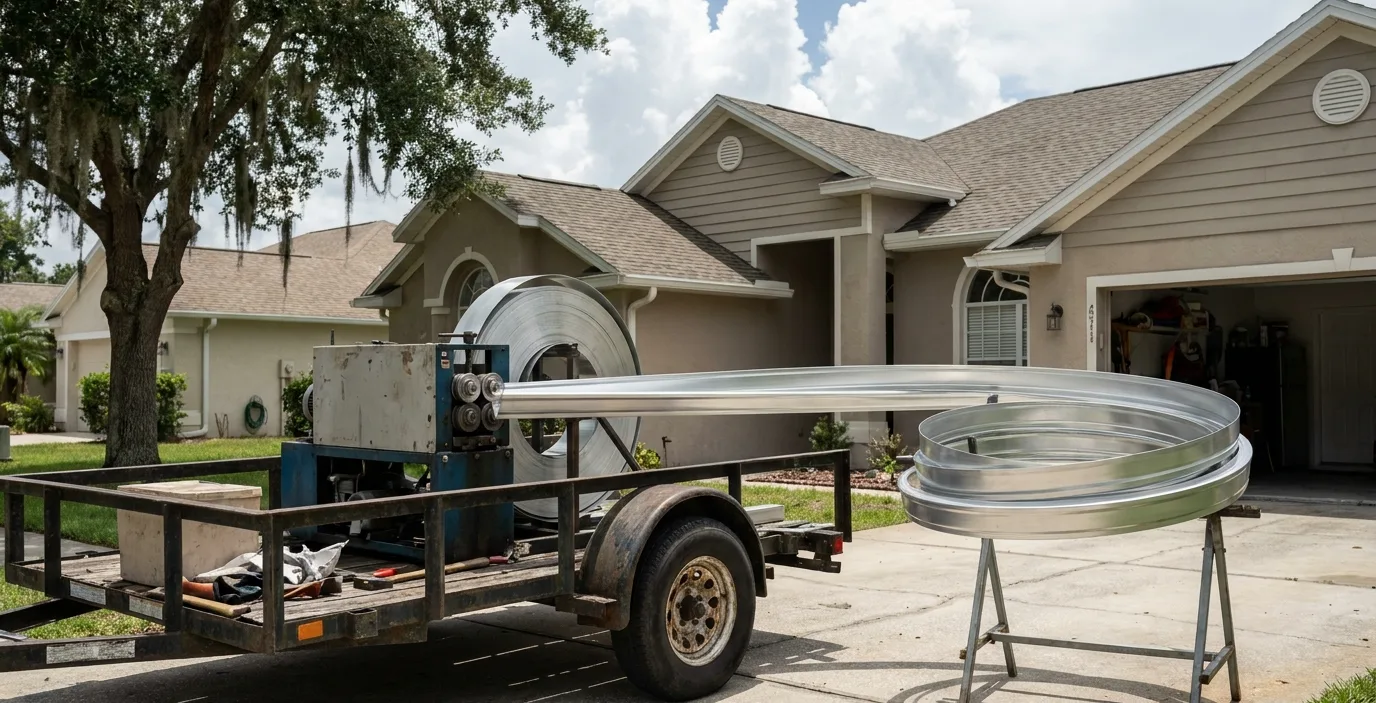
How a Seamless Run Comes Together
We show up with a roll-forming machine bolted to a trailer, a coil of flat aluminum stock, and a tape measure — not a stack of pre-cut ten-foot sections. The machine feeds flat coil stock through a series of rollers that bend it into a K-style or half-round profile, and it keeps extruding gutter for as long as we keep feeding metal through, so the piece coming off the far end matches your fascia board foot for foot. For a straight run along a garage or a single-story ranch, that often means one piece with no interruption at all from corner to corner.
Sectional gutters work the opposite way. They arrive on the truck already cut into ten-foot lengths and get joined end to end with slip connectors and sealant as the crew works down the fascia. Every one of those factory-length breaks is a seam whether the roofline needed one there or not — a forty-two-foot run gets four connectors it didn't have to have.
The trailer setup also means the finished gutter never rode on a truck bed or sat stacked against a wall waiting to be installed. There's no transport bend to straighten out and no risk of a length arriving slightly short and needing a splice nobody planned for. What comes off the rollers is shaped once, set once, and fastened — the same piece from the first hanger to the last.
Measure the roofline
We walk the fascia and mark every run, corner, and outlet location before the machine ever starts feeding coil.
Feed the coil
Flat aluminum stock runs through the forming rollers on the trailer, taking the K-style or half-round shape as it moves.
Cut to length on-site
Each run is cut to the exact footage of that section of fascia, not rounded up or down to match a factory length.
Set and fasten
The formed gutter is lifted into place, pitched toward the downspout outlet, and hung on hidden hangers screwed into the fascia board.
Why Seam Count Matters More Here Than the Sales Pitch Suggests
Central Florida doesn't get gentle rain for half the year — it gets fast, heavy, near-daily downpours through the summer stretch, and sectional gutters take a beating from that volume in a way a light spring shower never reveals. A slip-joint connector that stays dry and tight in April can start weeping by August, once it's been through months of afternoon storms swelling the aluminum and then baking it dry again by the next morning. Every joint is a place where two pieces of metal move independently of each other, and enough cycles of expansion and contraction eventually open a gap a seamless run never had to begin with.
Wind-driven rain during a tropical system behaves differently than an ordinary thunderstorm, too — it comes in sideways instead of straight down, and it finds any seam that isn't sitting flush against the fascia. A sectional run with a dozen joints along one roofline gives that sideways water a dozen chances to get behind the gutter instead of into it and down the downspout where it belongs. A run we form on your driveway that day has, at most, two or three joints for the whole house — at the corners, where a joint genuinely can't be avoided.
That's the real argument for forming gutters on-site rather than shipping them pre-cut: it's not that seams are inherently weak, it's that Orlando's rain volume gives every seam so many more chances to be tested than it would get almost anywhere else.
Where Seams Still Have to Exist
A formed run can't bend around a ninety-degree turn, so a handful of seams are unavoidable no matter how the gutter was made. What matters is how those specific points get closed off, and how much attention they get compared to a flat run that never sees a joint at all.
A seamless system concentrates every bit of that risk into a few known spots instead of spreading it across the whole roofline, which actually makes those points easier to check and maintain. On a sectional gutter, a homeowner has no way to know which of a dozen joints is the weak one until it's already leaking. On a seamless run, we can tell you exactly where to look — the two or three corners and the outlet — because there's nowhere else a joint could possibly be.
Corners
Inside and outside corners are mitered and joined with gutter-grade sealant plus rivets, since a single formed piece can't wrap around a turn in the fascia.
Downspout outlets
The outlet hole is cut into the formed run at the low point of the pitch, and the fitting is sealed and riveted in place before any downspout connects to it.
End caps
Every open end of a run gets a cap sealed on with the same sealant used at the corners, closing off the last few inches so nothing drips off the side.
Those three spots are also where we look first on an older seamless system that's started to drip, since a worn corner seal or a loose end cap is a common failure point on a run that's otherwise sound.
Color, Gauge, and Material Choices
Seamless doesn't mean one-size-fits-all. The coil stock itself comes in a range of finishes and thicknesses before it ever goes through the rollers, and the choice affects both how the gutter looks against your house and how it holds up over the years.
- Factory-baked finish — the color is baked onto the coil before it's ever formed, so it won't chip or peel the way a field-painted seam sometimes does.
- Standard and heavy-gauge aluminum — heavier stock holds its shape better under ladder pressure and debris load, worth the upgrade on a lot with heavy oak or pine canopy overhead.
- A wide range of color options — most homeowners match the fascia or trim rather than the roofline, so the gutter reads as part of the house instead of an obvious add-on.
- K-style or half-round profile — K-style holds more water and suits most asphalt-shingle roofs, while half-round is the traditional look many owners of older or tile-roofed homes ask for.
If you want something beyond painted aluminum entirely, we also form copper and half-round profiles for homeowners after a different look — those are worth a separate conversation since the material and hanging method both change.
Seamless vs. Sectional: What Changes for Your House
If your home already has sectional gutters with visible seams every ten feet, moving to a seamless system isn't a small tweak — it's closer to a full gutter installation, since the old sectional run comes down and a new one is formed in its place. The same logic applies if what you have is failing at several joints at once; at that point you're looking at a gutter replacement rather than a patch job on individual seams.
The trade-off homeowners weigh is usually upfront cost against long-term maintenance. Sectional gutters are cheaper to stock and quicker to hang off a truck, but every joint we didn't have to form on-site is a joint you'll eventually have to reseal or watch fail. A seamless run costs more the day it goes up and less over the years it stays on your house.
A run we form on the trailer for one house at Orlando Gutter Crew never has to guess at the length — it's cut to match the fascia we just measured, corner to corner, before it ever touches a hanger.
Frequently asked questions
Are seamless gutters really leak-proof?
No gutter is leak-proof forever, but a seamless run removes the joints that cause most leaks in the first place. The corners, outlets, and end caps still get sealed, and those sealed points are where a seamless system would eventually show a leak if one develops — not along a flat run the way a sectional gutter would.
Can a seamless gutter be repaired instead of replaced?
Yes, in most cases. A damaged section can be cut out and a new piece formed and spliced in, or a loose hanger, bent section, or failed corner seal can usually be fixed without touching the rest of the run. Full replacement only makes sense when the aluminum itself has corroded or the pitch has failed along most of the roofline.
What color options are available?
Aluminum coil stock comes in a wide range of factory-baked colors, and most homeowners match the fascia or trim board rather than the roofline itself. We bring color samples to the estimate so you can see how a shade looks against your actual siding before we form anything.
Do seamless gutters cost more than sectional gutters?
The material and labor to form a run on-site does cost more upfront than hanging pre-cut sectional pieces. Most homeowners make that back over time in fewer callbacks for leaking joints and less maintenance, since there are far fewer seams for debris and sealant failure to target in the first place.