
Gutter Installation in Orlando, FL
A gutter system that's undersized, poorly pitched, or hung with the wrong hardware tends to fail the first time it's really tested, not gradually — which is exactly why a proper install matters more here than in a drier climate.
Call (689) 400-8133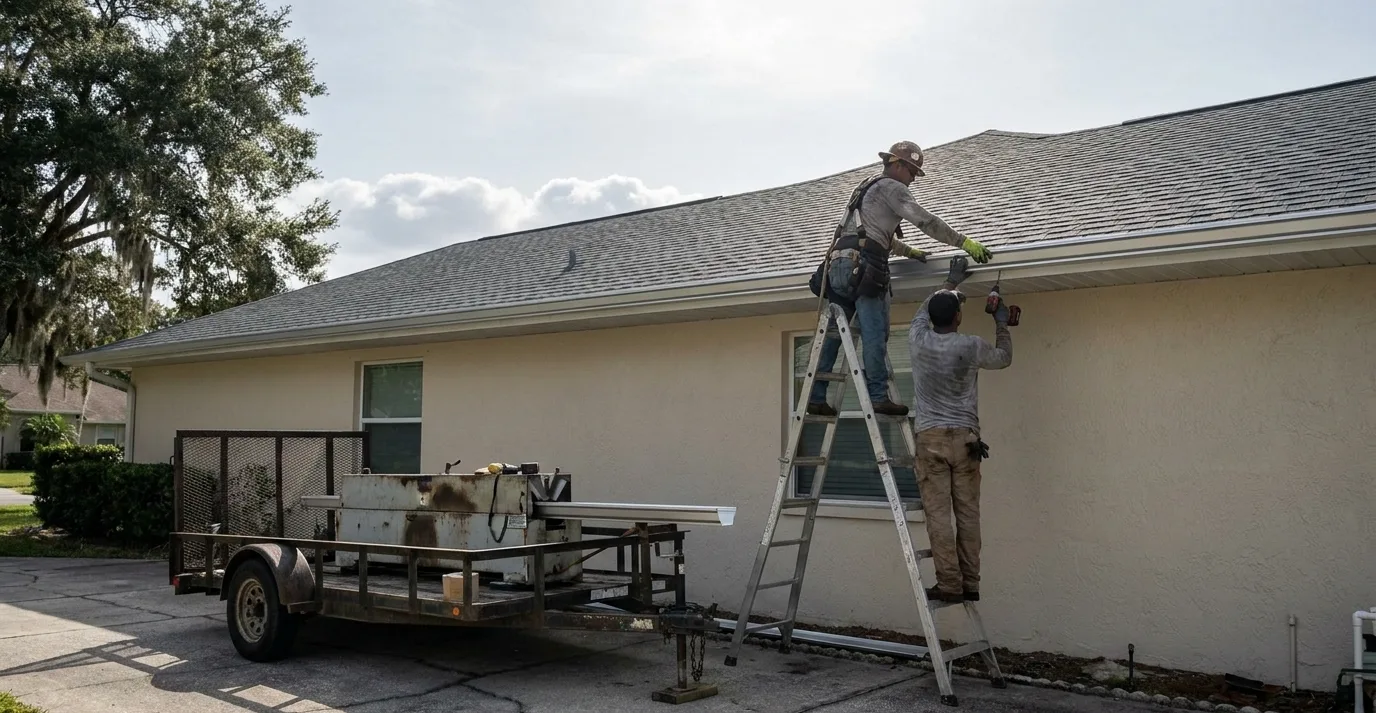
Why Installation Quality Matters in Orlando's Rain
A single afternoon thunderstorm in July can put more water on a roof in twenty minutes than a whole dry stretch of a week, and every drop of it has to go somewhere — down the slope, off the drip edge, and into a gutter that either keeps up or does not. That is the standard every install at Orlando Gutter Crew gets held to before we call a job finished.
Tile roofs and shingle roofs don't hand that water off the same way. Tile has a thicker, more textured drip edge and tends to shed water in a heavier, more concentrated sheet right at the eave; shingle roofs run a thinner, faster sheet across a smoother surface. A gutter hung without accounting for which one it's catching water from ends up either missing the sheet on a tile roof or getting overwhelmed at the corners on a shingle roof during a hard downpour.
Sizing a system correctly starts with roof area and pitch, not just the length of the fascia board. A steeper pitch moves water faster and concentrates it harder at valleys and corners, which is usually where an undersized system fails first. We size gutters and downspout count to the roof they're actually catching water from, not a generic rule of thumb applied to every house on the street.
This matters just as much on a modest single-story ranch as it does on a two-story home with three or four roof planes feeding into one valley. The math changes with every added plane, and a system sized for the front elevation alone will fall behind the moment a side roof starts dumping into the same run during a hard summer storm.
Choosing the Right Material
Aluminum is the standard for a reason — it holds up well in Florida's heat and humidity, it's light enough to hang without stressing an older fascia board, and it takes a baked-on finish that holds color for years without much upkeep. For most homes in Orlando, Winter Garden, or Apopka, a well-installed aluminum system is the right answer and the best value.
That said, material choice isn't purely about budget. A homeowner restoring an older bungalow, or one who simply wants a system that will outlast a couple of roof replacements, has real options worth weighing before defaulting to standard stock.
- Standard aluminum — the default choice for most homes, available in a range of factory colors to match trim and fascia.
- Seamless aluminum — fabricated on site to the exact run length, with no field seams for water or debris to catch on, and a cleaner line along the roof.
- Copper — a premium option that develops a natural patina over years, resists Florida's humidity and salt-tinged coastal air better than most materials, and holds up as well as anything we install.
If you're weighing seamless against a copper or half-round upgrade, it's worth reading about each option in more depth before deciding — the right choice usually comes down to the age and style of the house as much as the budget.
What a Proper Installation Includes
A gutter that looks right from the ground can still be wrong in ways that only show up the first time it rains hard. The details most homeowners never think to ask about are usually the ones that determine whether a system lasts a decade or gets replaced in three years.
- Hanger spacing — set close enough to support the gutter's weight when it's full of water, not just when it's empty and light.
- Slope — a gentle pitch toward each downspout, roughly a quarter inch of drop for every ten feet of run, set with a level rather than eyeballed.
- Downspout placement and extensions — positioned to move water away from the foundation, walkways, and planting beds instead of just off the roof.
- Drip edge integration — the gutter set so it actually catches the sheet of water coming off the roof instead of sitting just short of it.
- Fascia condition — checked before anything is hung, since a gutter is only as secure as the board it's fastened to.
That last point catches more homeowners off guard than any other. If the fascia behind an old gutter has gone soft, hanging a new one to it doesn't fix anything — it just delays the same failure by a year or two. We'll flag it before installation starts rather than after, and can handle fascia and soffit repair as part of the same job so the crew isn't back out a second time.
What Installation Day Looks Like
Most residential installs run start to finish in a single visit. Here's roughly how that day breaks down.
Final measurements
We confirm linear footage, downspout locations, and fascia condition against the quote before any material gets cut, so there are no mid-job surprises.
Old gutters come down
Existing gutters and loose hardware are removed and hauled off, and we take a look at what condition the fascia is in underneath before moving forward.
Seamless gutter fabricated on site
A portable machine forms the aluminum to the exact length of each run right in the driveway, so there's no seam in the middle of a straight section.
Hanging and pitching
Hangers go in at the correct spacing, and each run is set to slope toward its downspout and checked with a level, not just set by eye.
Downspouts and extensions installed
Downspouts are placed and connected, with extensions run out far enough to clear the foundation and any nearby beds or walkways.
Walkthrough and cleanup
We walk the property with you, point out anything worth knowing about the new system, and clear away cut-offs and old material before we leave.
When a Repair or Add-On Makes More Sense Than a Full Install
Not every call needs a full replacement, and we'd rather say so upfront than sell a bigger job than the house needs. If the gutters themselves are sound and the problem is a couple of sagging sections, a leaking seam, or one downspout that's never worked right, that's a repair call, not a reason to tear off a system that's otherwise doing its job.
The same goes for a house that just needs better capacity in one specific spot — a second downspout added where a long run overflows at one corner, or an extension added where water's pooling against the foundation. Those are targeted fixes, and they're usually a fraction of the cost of a full system replacement.
We'll tell you honestly which category a given house falls into during the same visit where we measure for a quote. If the fascia is solid, the hangers are holding, and the only issue is one bad section or an undersized downspout, that's what we'll quote — a full tear-off isn't the answer just because it's the bigger job.
The exception is age and material condition. If hangers keep pulling out of soft fascia, or the aluminum itself has started pitting and thinning in spots, patching the same three places every year usually ends up costing more over time than doing the replacement once and being done with it.
Frequently asked questions
How long does a gutter installation take?
Most single-family homes are a one-day job from tear-off to final walkthrough. Larger homes, multiple stories, or homes needing fascia repair first can run into a second day.
Can you match the color of my existing gutters or trim?
In most cases, yes. Aluminum gutter coil comes in a wide range of factory colors, and we'll match against your trim, fascia, or existing gutters as closely as the available stock allows.
Should I get 5-inch or 6-inch gutters?
It depends on your roof size and pitch rather than a fixed rule. Larger or steeper roofs generally move enough water that the larger size makes sense, while a smaller roof with a gentler pitch is often served well by the smaller profile — we size it to the house rather than default to one or the other.
Do you remove and haul away the old gutters?
Yes, that's included in a standard installation. Old gutters, brackets, and any loose fasteners are removed and hauled off as part of the job.
Do you warranty the installation?
Yes. Workmanship is covered, so if a hanger works loose or a seam opens up after installation, we come back and address it.