
Copper Gutters in Orlando, FL
Copper gutters are the one upgrade on this list that isn't really about function — aluminum keeps water off your roofline just as reliably. Copper is what you choose when you want the roofline itself to look like it was built to last a century, and in Orlando's sun and humidity, it will.
Call (689) 400-8133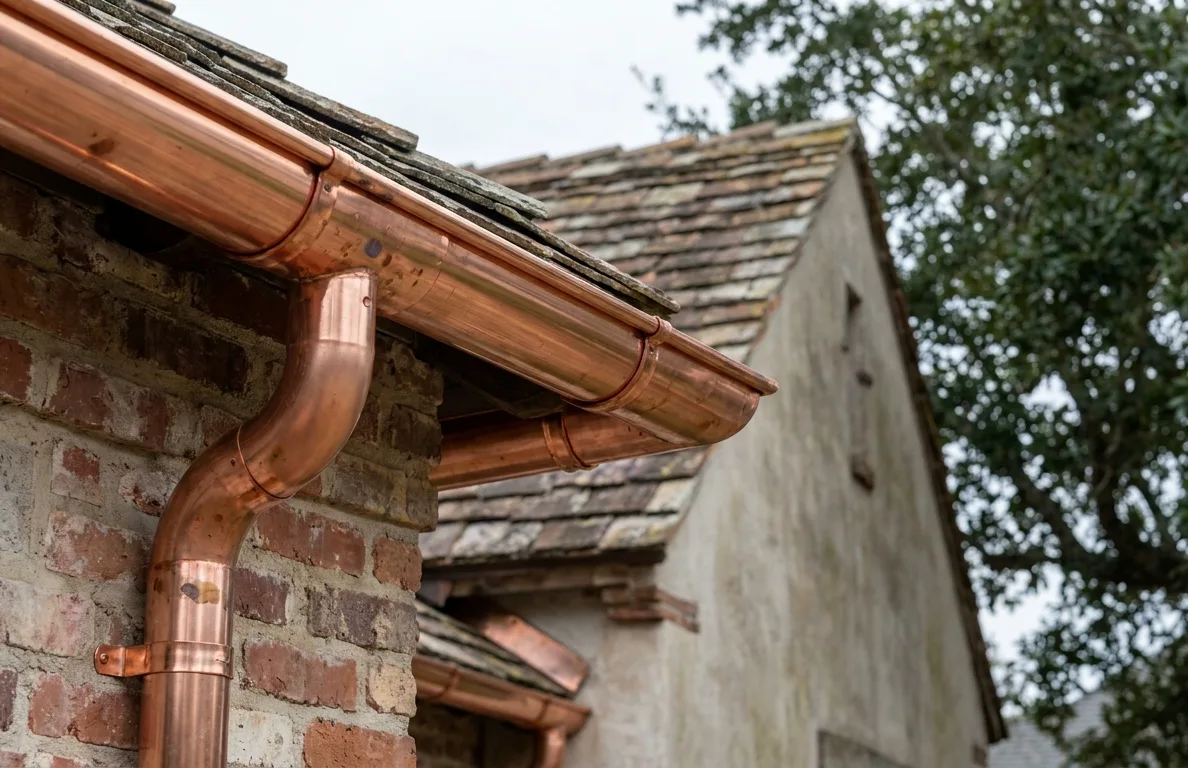
Why Orlando Homeowners Choose Copper
Aluminum gutters get painted, dent, and eventually get replaced. Copper does none of that. It ships bare, develops its own finish through oxidation, and shrugs off the kind of ladder bump or hail graze that leaves a crease in a painted aluminum run. For homeowners who think about the house in terms of decades rather than a single sale cycle, that durability is the whole pitch.
The honest trade-off is cost. Copper costs more to buy and more to install than aluminum or steel, and we won't pretend otherwise — it's a premium material with premium labor behind it. What changes the math is lifespan. An aluminum system gets replaced more than once over the life of a house; a well-fabricated copper system is often still doing its job when the next owner takes possession. Whether that trade makes sense for a given home is a conversation, not a formula, and it's one we're glad to walk through in person.
- No repainting, ever — copper doesn't need a coating to resist corrosion.
- Dent resistance — copper work-hardens instead of creasing under an errant ladder or falling branch.
- Resale character — a patinaed copper roofline reads as an investment, not a maintenance item.
- Longevity — copper gutter systems commonly outlast the roof they're mounted to.
How Copper Weathers in Central Florida's Humidity
Every copper gutter starts the same way: a bright, almost pink-orange penny color straight off the coil. Within the first several months of Orlando's humidity and sun, that brightness gives way to a darker russet-brown as the surface oxidizes. From there the color keeps shifting slowly over years, eventually settling into the muted brown-green patina most people picture when they hear 'copper roof.' The pace depends on exposure — a run under heavy tree canopy or facing away from direct sun will darken more slowly and unevenly than a run that gets full afternoon light, and that unevenness is normal weathering, not a flaw.
Humidity speeds oxidation compared with a dry climate, but Orlando isn't a coastal town — the salt load in the air here is much lighter than it is on the coast, which is one of the harder environments for any metal. Inland Central Florida sits in a middle zone: humid and warm enough that patina develops steadily, without the aggressive salt-driven pitting a beachfront copper installation has to contend with. Expect visible darkening within the first year and a settled, mottled patina developing over the years after that.
Fabrication and Installation: Copper Isn't Aluminum With a Different Finish
Standard aluminum gutter runs get crimped together and sealed with a compatible sealant at the joints — quick, effective, and appropriate for the material. Copper is worked differently. Seams get soldered, which means heat, flux, and a fabricator who has actually learned to sweat a clean copper joint rather than just crimp a metal coil. Done right, a soldered seam is effectively invisible and watertight for the life of the run; done poorly, it's the first place a system fails.
Every gutter we hang at Orlando Gutter Crew gets matched hardware — copper or bronze hangers and fasteners, never galvanized steel that reacts against the copper and stains or corrodes at every contact point.
That hardware detail sounds minor until you've seen a copper run that was hung with the wrong fasteners: dark streaking runs down from every screw within a year or two. Getting copper installation right means sourcing compatible hangers, using the right solder and flux for the alloy, and slowing down for a fabrication process that isn't interchangeable with an aluminum install. It's a different trade skill, and it shows in the finished roofline.
Architectural Styles That Suit Copper
Copper reads best against a house with some architectural weight behind it — brick, stone accents, a tile roof, deep eaves, the kind of craftsman, colonial, or Mediterranean-influenced design common across the older sections of Winter Park, College Park, and similar Central Florida neighborhoods. It tends to look out of place bolted flat and square onto a very plain modern elevation, and it looks exactly right curved into a half-round profile under a deep roofline.
That pairing — copper material in a half-round shape — is by far the most common request we get for this material. The curved trough and round downspouts read as historically accurate in a way a square K-style profile never quite does, and copper is the material that pairing was built around originally. If you're weighing the profile question separately from the material question, our half-round gutters page walks through that trade-off in more detail.
Craftsman and bungalow homes
Deep overhangs and exposed rafter tails give copper plenty of visible run to show off.
Colonial and traditional brick homes
Copper's warm tone plays well against red or tan brick without fighting the palette.
Mediterranean and Spanish-influenced homes
Tile roofs and stucco pair naturally with a half-round copper profile at the eave.
Living With Copper: Maintenance Realities
Copper doesn't need to be painted, sealed, or refinished, but it isn't maintenance-free in the way people sometimes assume. It's still a gutter, which means live oak leaves and pine needles will collect in it just like they would in an aluminum system, and a clogged copper gutter overflows exactly the same way a clogged aluminum one does. Seasonal cleaning still matters, especially heading into the heavier rain months.
The one maintenance issue specific to copper is contact with the wrong materials. Steel wool, certain acidic cleaners, and contact with dissimilar untreated metals can all disrupt the patina or cause staining, so cleaning a copper system is worth doing with the right method rather than whatever's under the sink. Beyond that, copper genuinely is the lowest-maintenance material we install over a multi-decade horizon — no recoating, no repainting, no UV-driven fading to manage.
A copper gutter system installed correctly is close to the last gutter decision a homeowner needs to make for that section of roofline.
Frequently asked questions
Does copper need any special maintenance compared to aluminum gutters?
It needs the same debris clearing any gutter needs, plus a little more care about what touches the surface — avoid steel wool or harsh acidic cleaners, which can disrupt the patina. Beyond that, copper needs far less upkeep over time than a painted material.
Will my copper gutters really turn green in Orlando?
They'll darken from bright copper to a russet brown fairly quickly, and continue shifting toward a muted brown-green patina over years. Full coastal-style verdigris takes longer inland than it does right on the coast, but the color will keep evolving — that's the material working as intended, not a defect.
Can copper gutters go on any home, or does the house need to suit it?
Copper can technically be fabricated for almost any roofline, but it reads best on homes with some architectural weight to match it — brick, stone, tile roofs, deep eaves. On a very plain, modern elevation it can look like an odd accessory rather than a natural fit, which is worth discussing before committing to the material.
How does the cost of copper compare to aluminum gutters?
Copper costs meaningfully more up front, both in material and in the specialized soldering labor it requires. The comparison that actually matters is lifetime cost: aluminum gets replaced multiple times over a house's life, while a well-installed copper system is built to outlast most of the other components on the roofline.