
Gutter Repair in Orlando, FL
A gutter system that's sagging, leaking, or pulling loose from the fascia doesn't need to come off the house — most of the time it needs a technician who knows exactly which section failed and why. Orlando Gutter Crew repairs gutters section by section, seam by seam, across Orlando and the surrounding suburbs.
Call (689) 400-8133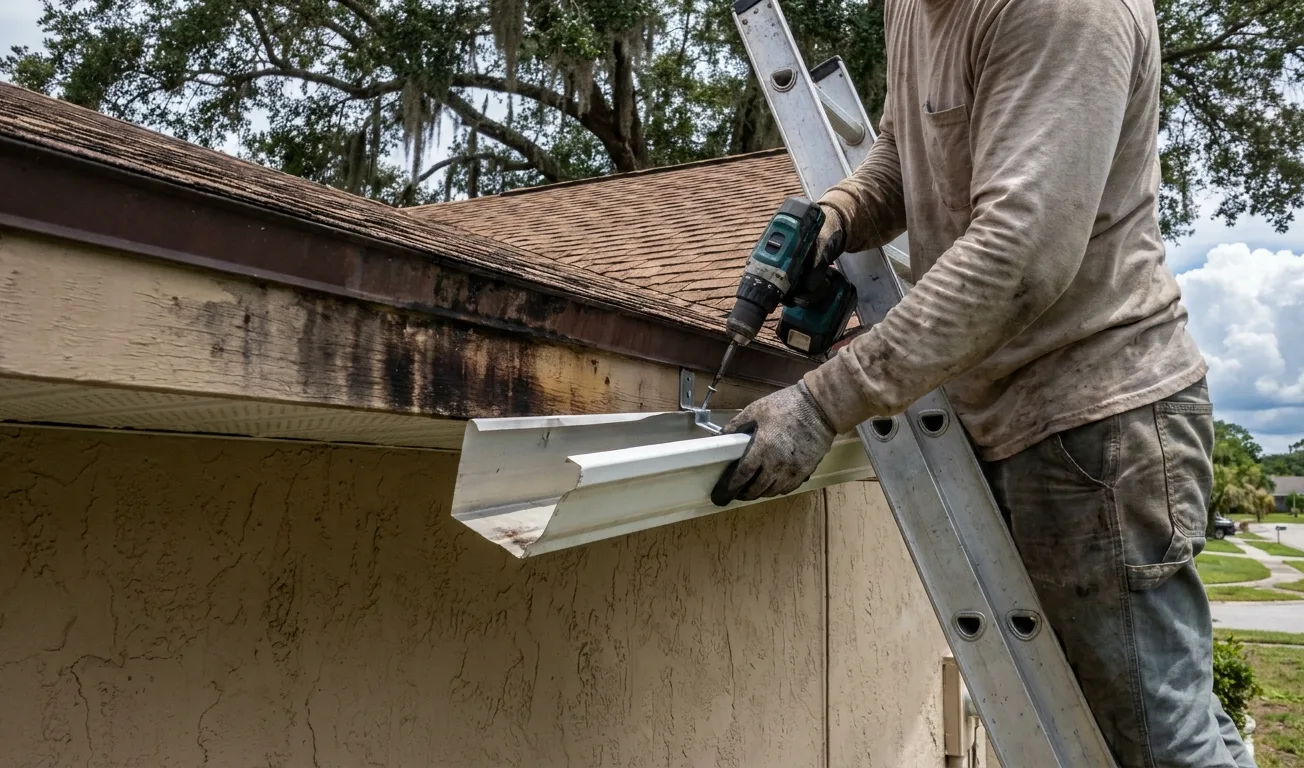
What Actually Breaks Around Orlando
Central Florida's rainy season puts a different kind of stress on a gutter than an ordinary shower does. When a thunderstorm rolls through with any real wind behind it, rain doesn't just fall into the gutter from above — it drives sideways under the roofline and backs up in sections that would drain fine on a calmer day. A gutter suddenly holding two or three times its normal water load starts working its hangers loose, and if that happens storm after storm across a summer, something eventually gives.
The fascia board underneath tells the same story from a different angle. Once it's been wet for long stretches during a wet season, the wood softens just enough that the screws holding your gutter on no longer bite the way they did when the house was new. That's why a lot of gutter failures show up right after a stretch of heavy weather instead of gradually over time.
- Sagging or pulled-away sections — hangers spaced too far apart, or driven into softened fascia, let a run bow downward until it holds standing water instead of draining it.
- Leaking seams and end caps — the sealant at a joint or cap dries out and cracks long before the metal around it wears out, and that's usually the first place a repair should start.
- Separated downspouts — a downspout worked loose from its outlet or elbow dumps water straight down the siding instead of away from the foundation.
- Holes and rust-through on older steel gutters — steel installed years ago starts pitting and then punching through at the low points, usually near an inside corner or an outlet.
- Improper slope and standing water — a gutter that was never pitched correctly, or has settled out of pitch, holds an inch or two of water after every storm and speeds up corrosion.
Repair or Replace? Here's the Honest Version
We'd rather repair three bad sections on an otherwise sound system than push a full replacement you don't need yet.
That kind of judgment call is exactly how Orlando Gutter Crew built its reputation in this market before the reviews caught up.
If your gutters are pulling away in one or two spots, the seams are leaking but the metal itself is solid, or a downspout knocked loose in the last storm, a repair gets you back to full function for a fraction of what a new system costs.
The calculation changes once a system is failing in more places than it's holding. Gutters pulling away from the fascia in three, four, or more separate runs usually means the fastening problem is systemic, not local — patching one section just moves the next failure a few feet down the roofline. Steel gutters with rust visible at more than one point, or aluminum that's been crimped, dented, and re-hung so many times the metal itself has fatigued, are also past the point where a repair makes financial sense.
In those cases we'll say so plainly and walk you through what a full replacement involves, rather than billing for a repair that won't hold through the next named storm.
What Happens During a Repair Visit
Every repair call starts with a real inspection, not a guess from the driveway. Here's the sequence a typical visit follows once a technician is on your roofline.
Inspection and diagnosis
A technician walks the roofline, checks every hanger, seam, and downspout connection, and identifies exactly which sections are failing and why.
Straightforward pricing on the spot
You get a repair quote broken down by section before any work starts, not a vague estimate that changes once the ladder goes up.
Re-securing and re-pitching
Loose sections get new hangers driven into solid wood, and any section that's lost its pitch gets reset so water actually reaches the downspout instead of pooling.
Sealing seams and end caps
Failed sealant gets cut out and replaced at every seam and cap along the repaired run, not just the one that's visibly dripping.
Downspout reattachment and cleanout
Separated downspouts get reset and secured, and we clear anything blocking the elbow or underground drain line while we're already there.
Final water test
We run water through the repaired sections before we leave so you see it draining correctly, not just take our word for it.
Storm Damage Isn't Always Obvious
A tropical system doesn't just dump more rain — it drives that rain sideways under drip edges and roof valleys a normal afternoon storm never reaches, and it can pull a gutter loose that looked perfectly fine the day before. After a named storm moves through Central Florida, it's worth having someone check hangers, seams, and downspouts even if nothing looks obviously wrong from the ground, because a hanger that's half-pulled today is the one that lets go completely in the next round of weather.
If a recent storm is the reason you're on this page, our storm damage repair crew handles that work specifically — it's worth a look before you assume the whole system needs to come down.
Frequently asked questions
How do I know if my gutters need a repair or a full replacement?
It usually comes down to how many spots are failing and what condition the metal is in. A couple of sagging sections, a leaking seam, or one loose downspout on an otherwise straight, rust-free system is a repair. Multiple sections pulling away at once, visible rust in more than one place, or metal that's been bent and re-hung repeatedly is a sign the system has reached the end of its useful life.
Do you fix gutters that another company installed?
Yes. Most of our repair calls are on systems we didn't originally hang. We'll assess what's there on its own merits — the brand or installer on file doesn't change how we diagnose a failed hanger or a leaking seam.
How fast can someone come out for a repair?
For an active leak or a section that's actively pulling away, we prioritize getting a technician out quickly rather than booking weeks out, especially during rainy season when a small problem gets worse fast. Call (689) 400-8133 and we'll give you a real timeframe based on what's happening at your house.
Does a sagging gutter mean my fascia is rotten too?
Not always, but it's common enough that we check every time. A gutter can sag purely from undersized or poorly spaced hangers with the fascia still in good shape underneath. Other times the fascia has softened from prolonged moisture and that's the real reason fasteners won't hold. We inspect the wood as part of every repair visit so you know which situation you're dealing with before we close it back up.