
Downspout Repair in Orlando, FL
A gutter can be completely clear and still fail you if the downspout underneath it can't keep up. The crew at Orlando Gutter Crew traces every downspout back to the gutter run it drains before deciding what actually needs fixing.
Call (689) 400-8133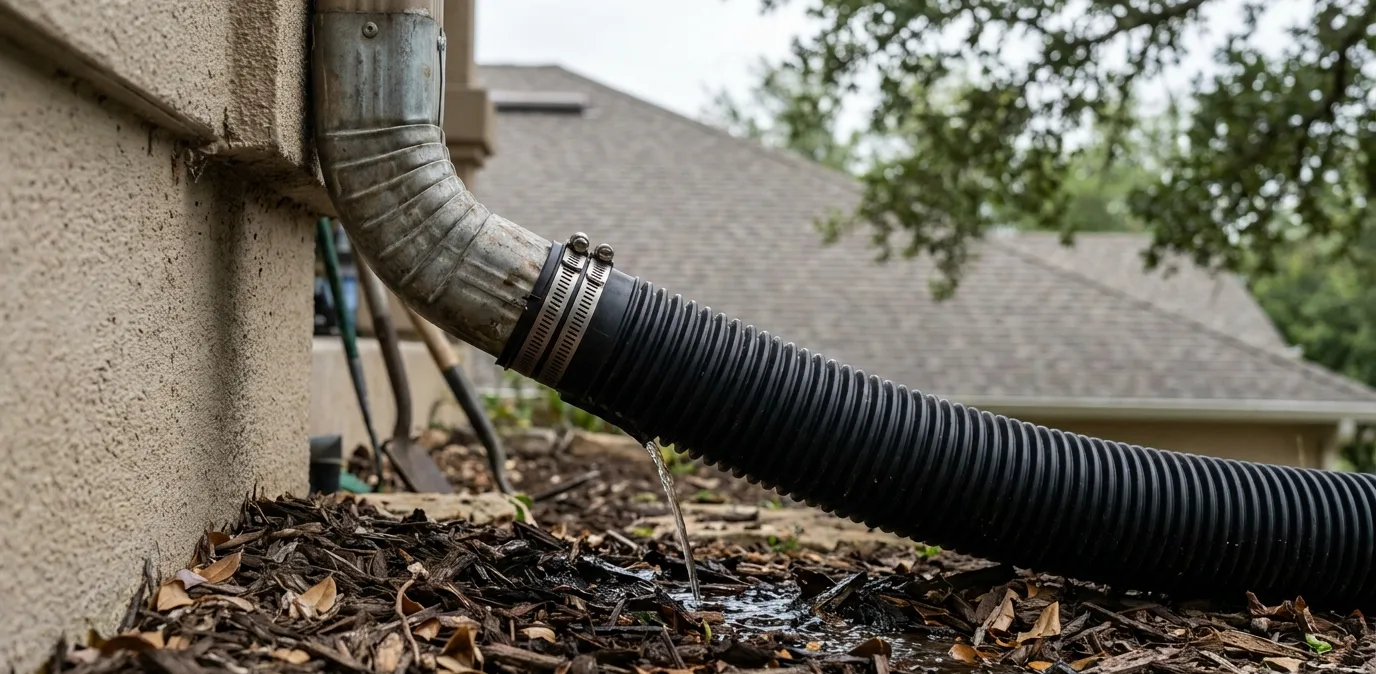
Why Downspouts Overflow Even When the Gutters Are Clean
Homeowners usually assume an overflowing downspout means clogged gutters, and sometimes it does. But a lot of the calls we get are for gutters that are completely clear, on a downspout that's overwhelmed anyway, because Orlando thunderstorms don't arrive as a steady drizzle. They arrive as a fast, intense burst — a huge volume of water hits the roof in a short window, runs into the gutter, and reaches the downspout outlet faster than a single narrow pipe can carry it away. The gutter does its job and fills the downspout past capacity anyway, and water starts spilling over the outlet or backing up over the gutter's front edge.
That's a different problem than a slow clog, and it calls for a different fix. Sometimes the downspout itself is undersized for the roof area it serves. Sometimes it's sized fine but disconnected or crushed somewhere along its length, so the water that does make it into the pipe never reaches the ground where it's supposed to.
We hear this from homeowners who already paid for a gutter cleaning that summer and are confused why the same corner of the house is still flooding after every storm. It's not that the cleaning didn't work — it's that nobody looked at what happens after the water leaves the gutter. A downspout that's fine on a normal rainy afternoon can still be the exact spot that fails during the kind of sudden, heavy burst Central Florida gets most summer days, simply because burst intensity and average rainfall are two different tests, and a downspout only has to fail one of them to cause a problem at your foundation.
The Failures We See Most Often
Downspout problems tend to fall into a handful of repeat patterns once you've looked at enough of them.
Disconnected sections
The lower section pulls apart from the elbow above it — often from a lawn mower, a ladder, or just years of expansion and contraction — and water dumps straight down the wall instead of reaching the extension.
Crushed or dented pipe
A vehicle, a fallen branch, or a pressure washer wand can dent a downspout enough to choke the channel, so water backs up and overflows at the top even though the pipe isn't blocked by debris.
Undersized outlets
A long or steep roof plane feeding a single narrow downspout will overflow in a hard burst no matter how clean the gutter is, simply because the outlet can't pass water as fast as the roof delivers it.
Missing or damaged extensions and splash blocks
Without something to carry water past the foundation, it drops straight down at the wall and pools there, which is often the real source of a damp baseboard or a soft spot in the lawn.
Most homes we visit have two or three of these stacked on top of each other — an undersized outlet that was borderline to begin with, feeding a downspout with one loose joint, emptying onto bare dirt with no extension at all. Fixing only the most obvious of the three usually means the homeowner calls back the next time it storms hard, still confused about why the same spot is wet, so we walk through all four of these before we call a repair finished.
Matching the Downspout to the Gutter Run It Serves
A downspout isn't sized in isolation — it has to match the roof area and gutter length feeding into it. A short run off a porch roof can get by on a narrow outlet and pipe. A long run collecting water off a full roof plane, or two roof planes that were tied into one gutter run to save a downspout, needs a wider outlet and often a second downspout altogether rather than a bigger pipe at the one location. When we're called out for repeated overflow at a single downspout, checking whether it's actually undersized for the run is one of the first things we do, before we assume the fix is just clearing debris or resealing a joint.
This matters more on additions and remodels than most homeowners expect. A screened porch or a garage tacked onto the original house often gets tied into whatever gutter run was closest, instead of getting its own downspout sized for the new square footage. Years later that shows up as one downspout that overflows every time it storms while the rest of the house drains fine, and the fix isn't a bigger pipe — it's giving that added roof area an outlet of its own.
Getting Water Further From the Foundation
Fixing the downspout itself only solves half the problem if the water still lands right next to the house once it exits the pipe. A short elbow that dumps onto a splash block a foot from the wall will still saturate the soil against your foundation over a rainy season, even with a perfectly functioning downspout above it.
- Surface extensions — rigid or flexible pipe that carries water several feet further from the wall, either left in place or made removable for mowing.
- Buried extensions — a solid pipe run underground to a pop-up emitter or a discharge point well away from the house, for yards where a surface extension isn't practical or gets in the way.
- Splash blocks and diverters — a lower-cost option for a downspout that just needs to stop concentrating water in one spot on grade near the foundation.
When a homeowner's real issue is water pooling across a wider stretch of yard rather than just at one downspout, that's usually a bigger drainage question than a single pipe can answer, and it's worth looking at the yard as a whole instead of one outlet at a time.
Repair or Replace: How We Make the Call
Most downspout problems are repairs, not replacements. A disconnected joint gets reseated and fastened, a dented section gets swapped for a new length of matching pipe, and an outlet that's the wrong size gets enlarged or split into two without touching anything else on the house. Full downspout replacement usually only comes up when the pipe has corroded through in multiple spots, when a homeowner is changing the color or profile to match new seamless gutters going in at the same time, or when a downspout was routed badly to begin with and needs to move to a better location along the fascia.
Either way, the diagnosis happens during a real storm whenever we can manage it, or with a hose test when the weather won't cooperate. Watching where water actually goes wrong — rather than guessing from a dry inspection — is what keeps us from replacing a downspout that only needed one joint reseated, or patching a joint on a downspout that was undersized from the day it went in.
We'll also flag anything downspout-adjacent that isn't actually a downspout problem, since those tend to get blamed on the wrong part of the system. A gutter that's pitched wrong will starve a perfectly good downspout of water on one end of the run and flood it on the other, and no amount of downspout work fixes that — it's a hanger and pitch issue upstream. Telling the two apart before we start is part of getting the repair right the first time instead of the second.
Frequently asked questions
Why does water keep pooling near my foundation?
Most of the time it's one of two things: the downspout has no extension or splash block, so water drops straight down at the wall, or the downspout is disconnected somewhere along its length and never makes it to grade at all. Both are usually quick fixes once we can see the actual path the water is taking during a storm.
How many downspouts does a house need?
It depends on the roof area feeding each gutter run, not on the size of the house. A compact roof with a couple of short runs might only need two downspouts, while a larger or more complicated roofline can need four or more to keep any single outlet from being overwhelmed during a heavy burst.
Can a downspout be run underground?
Yes. A solid buried pipe can carry water from the base of the downspout to a pop-up emitter or another discharge point well away from the house. It takes more planning than a surface extension since it has to be pitched correctly and kept clear of tree roots, but it's a clean option where a visible extension isn't practical.
Do you repair just the downspout without touching the gutters?
Yes. A lot of what we do is downspout-only work — reconnecting sections, replacing a crushed length of pipe, resizing an outlet, or adding an extension — with no work needed on the gutter run above it.