
Commercial Gutters in Orlando, FL
Commercial gutter systems are not just a bigger version of what Orlando Gutter Crew hangs on a house next door — low-slope and flat roofs move water through box gutters, scuppers, and internal drains built for a different scale of volume entirely. Getting that system wrong on a retail strip or warehouse roof isn't a minor inconvenience; it's a real property and inventory risk.
Call (689) 400-8133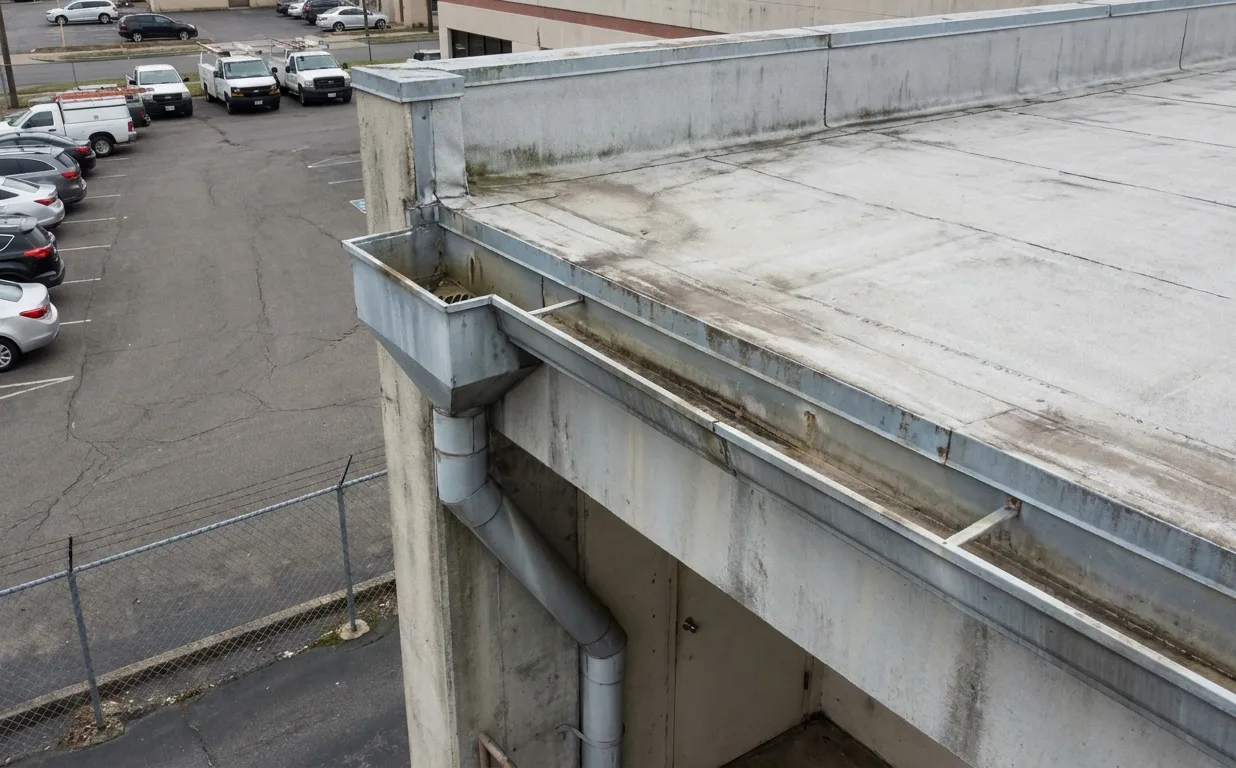
How Commercial Gutter Systems Differ From Residential
A house sheds water off a pitched roof into a gutter mounted along the eave, and from there into a couple of downspouts. A low-slope or flat commercial roof works differently from the ground up. Water is often collected in a box gutter built into the roof edge or behind a parapet wall, routed out through scupper openings punched through that parapet, and carried down through much larger conductor heads and downspouts than anything on a residential job — or, on some buildings, routed internally through roof drains and tied into the building's plumbing rather than run down the exterior at all.
The volume math changes too. The same intense summer downpour that a house handles across dozens of feet of eave and several downspouts, a commercial roof might be funneling into a handful of drain points serving thousands of square feet of contiguous surface. When one of those points is undersized, clogged, or failing, the water doesn't have anywhere else to go — it pools, and on a low-slope roof, pooling water finds its way to the weakest point in the membrane a lot faster than most owners expect.
What a Drainage Failure Actually Costs a Commercial Property
On a house, a clogged gutter overflowing onto a flowerbed or staining a fascia board is an annoyance to fix on the next nice weekend. On a commercial building, the same category of failure has a different price tag attached. A backed-up scupper or an undersized box gutter can mean standing water finding a seam in the roof membrane, water intrusion into a ceiling over retail floor space or warehouse inventory, or a parking lot drainage problem that becomes a liability issue rather than a maintenance note. The stakes on a commercial roof are measured in inventory, downtime, and tenant relationships, not just curb appeal.
Commercial landscaping adds its own debris load to the picture. A retail pad site or office park planted with live oak and crape myrtle sheds into box gutters the same way a house does, but a property with parking-lot islands full of queen palms or Washington palms is dealing with something different — palm fronds and seed pods that are heavier and stiffer than residential leaf litter, and that can wedge across a scupper opening and block it outright rather than just slowing the flow. A drainage assessment on a commercial property has to account for what's actually planted around the building, not just the roof itself.
Properties We Service
We work across the range of low-slope and flat-roof commercial building types common around the Orlando area, and the drainage plan changes with the property type.
Retail strips and shopping centers
Multiple roof sections and tenant spaces often means multiple drainage systems to coordinate on one property.
Office buildings
Parapet-wall scupper systems and box gutters sized for a large, uninterrupted roof deck.
Warehouses and industrial buildings
High water volume off a large flat roof surface, with inventory below that can't tolerate a leak.
HOA and multifamily common buildings
Clubhouses, leasing offices, and amenity buildings that fall under a property management or HOA contract rather than a single homeowner.
Maintenance Contracts vs. One-Off Service
A single-family home might call for gutter service once or twice a year, scheduled whenever it's convenient. Commercial properties are usually better served by a standing maintenance contract instead of a series of one-off calls — regular scheduled cleaning and inspection of box gutters, scuppers, and drain tie-ins, timed around the rainy season and any heavy leaf or debris fall specific to the property's landscaping. A contract also means documented service history, which matters for insurance, property management reporting, and liability if a drainage failure is ever disputed.
For a multi-building or multi-tenant property, standing service also solves a coordination problem a one-off call doesn't: one point of contact, one schedule, and one company that already knows the roof layout instead of relearning it every time something backs up.
How a Commercial Assessment and Quote Works
We keep the front end of a commercial job simple: an in-person look at the roof before anything gets priced.
Site walk
We walk the roof and drainage points in person — box gutters, scuppers, downspouts, and any internal roof drain tie-ins — rather than quoting from a satellite photo.
Drainage capacity check
We evaluate whether the existing system is actually sized for the roof's total drainage area, not just whether it's currently functioning.
Proposal
You get a written proposal covering the scope of work, and, where it makes sense, a standing maintenance schedule instead of a one-time fix.
Property managers and owners who bring us in for that first site walk usually end up keeping us on as the standing maintenance contact, simply because the assessment already did the hard part of mapping the roof.
Frequently asked questions
Do you offer ongoing maintenance contracts for commercial properties?
Yes — for most commercial and multi-tenant properties, a standing maintenance schedule makes more sense than a series of one-off calls, and we set those schedules around the property's specific drainage needs and rainy-season timing.
What types of commercial properties do you service?
Retail strips, office buildings, warehouses and industrial buildings, and HOA or multifamily common-area buildings are the properties we work on most, along with any low-slope or flat-roof structure that relies on box gutters and scuppers rather than a residential-style gutter.
Can you handle a multi-building HOA or property-management account?
Yes, that's a common account type for us. One point of contact and one coordinated schedule across multiple buildings on a single property is usually simpler for the management side than juggling separate vendors per building.
How is commercial gutter pricing structured?
It's scoped per property rather than quoted off a flat rate, since roof size, drainage complexity, and whether a standing maintenance contract is involved all factor in. The site walk and drainage assessment are what a proposal is based on.