
Gutter Cleaning in Orlando, FL
Oak leaves don't blow off an Orlando roof the way they do up north — they land wet, mat down, and stay put until somebody pulls them out by hand. Add a summer's worth of pine needles working into the seams, and a gutter that looked fine in April can be shedding water down the siding by July.
Call (689) 400-8133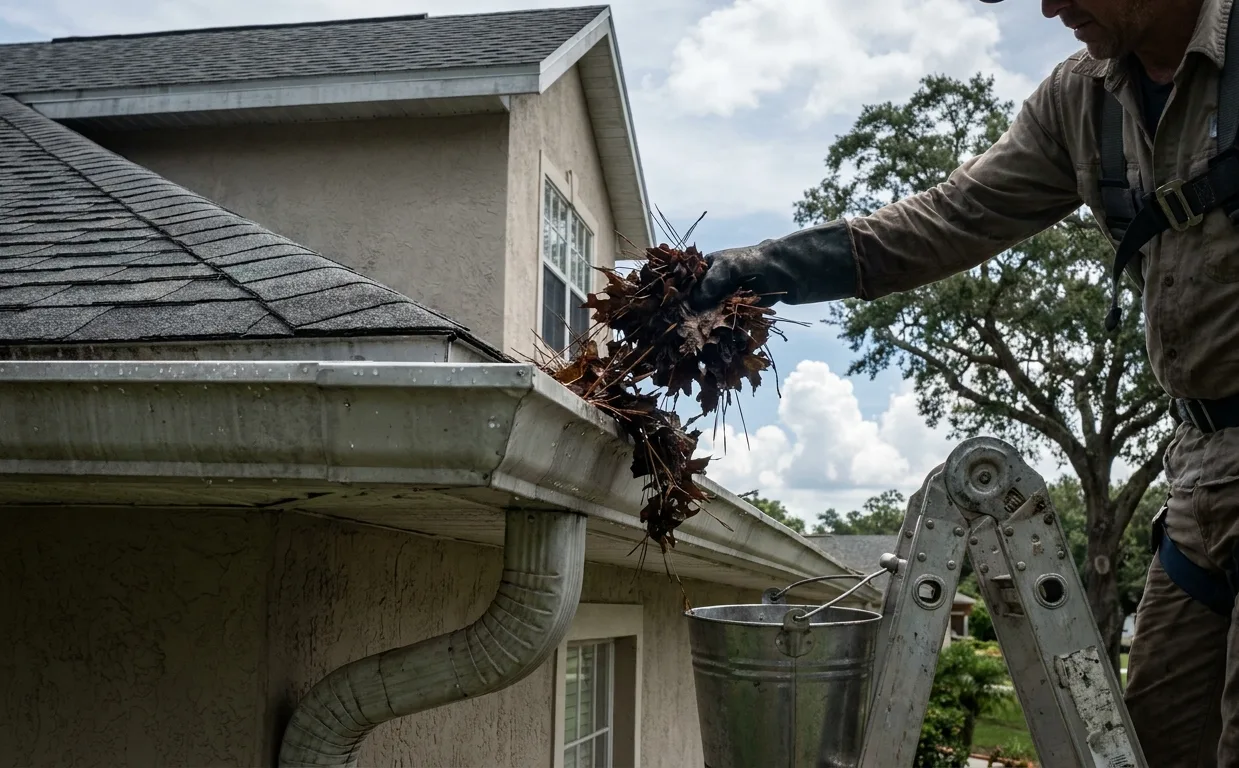
Why Central Florida Gutters Clog on Their Own Schedule
Crews at Orlando Gutter Crew see both problems on the same street, often on the same roof, because most established yards here carry a mix of the two trees.
Central Florida's canopy runs heavy to live oak and slash or longleaf pine, and the two trees foul a gutter in almost opposite ways. Oak leaves fall broad and wet, and once a few layers stack up they press flat into a dense mat that shingles over itself, closer to a patch of sod than to loose leaf litter. Pine needles do the reverse: they're narrow enough to slip through the gap under a loose hanger or a warped guard, and they keep arriving until they've woven themselves into a layer water has to fight its way through.
When either kind of debris packs in tight, a normal summer afternoon storm doesn't just fill the gutter, it stalls it completely. Water backs up behind the clog, climbs over the front lip, and runs straight down the fascia board instead of finding the downspout. That's a very different failure than a slow trickle somewhere colder; it's a full storm's worth of runoff hunting for the fastest way down, and it usually finds the exterior paint, the soffit venting, or a flower bed planted right against the foundation.
How Often Orlando Roofs Actually Need Attention
Homeowners who moved here from a drier climate tend to plan cleanings around a calendar that doesn't apply anymore. Up north, gutters mostly deal with one heavy leaf drop in autumn and maybe some ice in winter. Here, live oaks shed unevenly across most of the year, spring pollen cakes a fine film onto everything it touches, and the rainy stretch running roughly June through November puts every clog to the test on an almost daily basis. A schedule built for one leaf season leaves a Central Florida roofline unchecked for most of the year it actually needs watching.
- Heavy oak or pine canopy overhead: plan on a cleaning in spring once pollen and the first leaf drop have settled, and another before the rainy season builds so the system starts hurricane season clear.
- Open sky with little canopy nearby: once in late spring and once heading into winter usually keeps up, though it's still worth a look after any named storm rolls through.
- Single-story homes with a low, shallow roof pitch: these hold water longer once they're blocked, so they're worth checking on the shorter end of either schedule above.
None of these are rigid rules — a property backed up against a stand of pines will always need more attention than one shaded by a single oak thirty feet from the roofline, and we'll tell you honestly which one yours is after the first visit.
What Happens During a Cleaning Visit
A cleaning call is more than running a leaf blower along the roofline. Here's the order we work in on a typical Central Florida house:
Clearing the trough by hand
Where oak debris has matted down, we scoop it out by hand, glove to gutter, because a shop-vac or blower alone won't break up a mat that's already knitted together.
Vacuuming and blowing the lighter buildup
Once the heavy mat is out, a gutter vacuum or blower clears the loose grit, seed pods, and looser needles faster and cleaner than hand-scooping the whole run.
Flushing every downspout
We run water down each downspout from the top, checking that it exits freely at the bottom — a clear trough with a clogged downspout still backs up in the next storm.
Checking hangers, seams, and fascia while we're up there
Since we're already on the ladder, we look at hanger spacing, seam sealant, and the fascia board itself for soft spots or fastener pull-through, and flag anything beyond normal wear.
A final rinse and ground-level walk
We rinse the exterior of the gutter face where staining has set in, then walk the property from the ground to confirm water is exiting where it should.
Signs You're Overdue, Visible From the Ground
You don't need a ladder to know a gutter's in trouble. A few minutes walking the perimeter after a storm tells you most of what you need to know:
- Dark streaking down the fascia or siding: water that should be inside the gutter is running down the outside face instead, usually right below a low spot in a clog.
- Grass, weeds, or small seedlings growing out of the gutter: enough decayed leaf matter has built up to hold soil and moisture — this doesn't happen in a system that's draining properly.
- A visible sag or wave in the gutter run: standing water is heavier than most people expect, and a few gallons trapped in one section will pull hangers loose over time.
- Water pooling near the foundation after rain: if downspouts aren't carrying water away from the house, it's landing right where you don't want it.
Any one of these is worth a call before the next storm, not after.
When Guards Make More Sense Than Another Cleaning Call
Some properties genuinely don't need guards — a single well-placed oak and an open southern exposure might only call for two visits a year, and that's cheaper over time than a guard installation. But a property sitting under a dense pine canopy, where needles are arriving nearly every week for months at a stretch, is a different case. At that point, repeat cleanings start costing more across a few years than a one-time guard install would, and the guards cut down on how often anyone has to be on the ladder at all.
If you're not sure which side of that line your property falls on, a look at our gutter guards page will walk through the honest tradeoffs, or we can pair a cleaning with a full gutter inspection to check the whole system at once, not just what's visible from the ladder.
Frequently asked questions
How often should gutters actually be cleaned in Orlando?
Most homes with meaningful oak or pine cover do best with two cleanings a year — once after spring pollen and leaf drop settle, and again before hurricane season builds through the summer. Open, less-shaded properties can often stretch to once or twice a year on a similar schedule, though a storm with heavy wind should always trigger a look regardless of when the last cleaning happened.
Is it safe to clean my own gutters?
Physically, plenty of homeowners do it themselves on a single-story house with a stable ladder and someone holding it. The bigger risk in Central Florida is what's hiding under the debris — soft fascia, a pulled hanger, or a seam that's already failing — which is easy to miss if you're focused on clearing leaves rather than inspecting the hardware underneath them.
Do you check for damage while you're cleaning?
Yes, every visit includes a look at hangers, seams, and the fascia board while we're already up on the ladder. We'll point out anything that needs repair rather than just clearing the debris and moving on, since a clean gutter with a failing hanger is still going to sag.
Do you clean the roof valleys too, or just the gutters?
We check valleys as part of the same visit when they're accessible, since a valley packed with needles or leaf debris feeds straight into the gutter below it and will re-clog it within weeks if it's left alone. It's not a full roof cleaning, but we clear what's actively draining into the gutter system.