
Fascia and Soffit Repair in Orlando, FL
Fascia and soffit rarely fail on their own. By the time the wood along your roofline is soft enough to notice, water has usually been getting behind an overflowing or poorly seated gutter for at least one full rainy season. We repair the damaged wood and fix what let the water in, in the same visit.
Call (689) 400-8133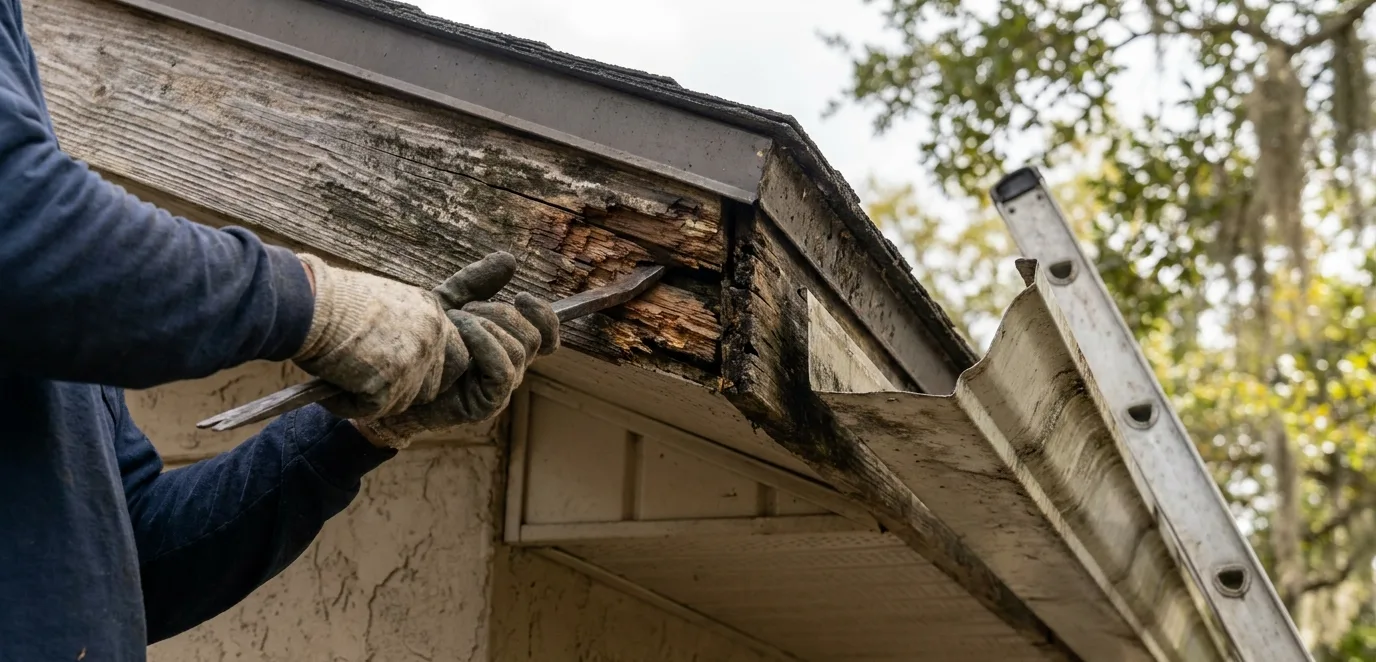
What Fascia and Soffit Actually Do
Fascia is the flat board that runs along the edge of your roofline, right behind the gutter. It is not decorative trim — it is structural. Your gutter hangers screw directly into it, which means the fascia board is what actually carries the weight of a full gutter run during a downpour, not the roof edge itself.
Soffit is the panel underneath the roof overhang, the part you see when you look straight up at the eave. It closes off the attic from the outside while still letting air move through vented sections, which keeps the attic from turning into a heat trap and keeps birds, wasps, and rodents from moving in through the gap between roof and wall.
When either one is built from wood — still common on Orlando homes built before vinyl and aluminum trim became standard — sustained moisture is the one thing they cannot tolerate for long.
A lot of the older homes we work on around College Park, Winter Park, and the Conway area were built with wood fascia and wood soffit, sometimes wrapped later in a thin aluminum shell that covers the board instead of replacing it. That wrap can actually make rot harder to spot from the ground, since the metal keeps looking clean long after the wood underneath has started to go.
Signs Your Fascia or Soffit Has Rot Damage
You usually catch this from the ground before you catch it up close. A handful of patterns show up again and again on inspections around Orlando and Winter Park:
- Soft or crumbling wood — press a screwdriver or your thumb into the board where the gutter attaches; healthy wood resists, rotted wood gives
- Peeling or bubbling paint along the fascia line, which is almost always trapped moisture pushing the paint film off from underneath
- A gutter that has started to sag or pull away in one stretch while the rest of the run still looks straight
- Visible daylight or gaps between the fascia and the roof deck, or between adjoining soffit panels
- Wasps, bees, or rodents getting into the attic through a soffit seam that used to be sealed tight
- A hollow or spongy sound when you tap the board with a knuckle, even where the paint still looks intact
Any single item on this list is worth a call before it spreads. Catching rot at six inches of board is a repair. Catching it after it has traveled ten feet down a run, or reached the roof deck itself, turns into a much bigger project.
Why This Is Almost Always a Gutter Problem First
We rarely find fascia rot that started with the fascia. It starts with a gutter that is clogged, pitched wrong, pulling away from the wall, or simply undersized for how hard Central Florida rain falls between June and November. Water that should run down the trough instead spills over the back lip and lands directly on the top edge of the fascia board, run after run, storm after storm.
The fascia rarely fails by itself — at Orlando Gutter Crew we treat the rotted board and the gutter that caused it as one repair, because on almost every Orlando roofline, one problem created the other.
On a lot of Orlando roofs, the debris that starts this chain is more organic material than dirt — live oak leaves and pine straw settle into a run, hold water against the back seam, and the gutter starts backing up long before anyone notices a leak from inside the house.
We have opened up fascia on homes where the rot clearly dated back two or three rainy seasons — you can tell from how far the damage has traveled and how many hanger holes have gone soft. Nobody set out to ignore a leaking gutter for three years; it is just that an overflow at the back of a trough, hidden behind the gutter itself, is not something you notice from the driveway the way a clogged downspout or a sagging front edge is.
If you are already seeing rot, the honest first question is not how we patch the wood — it is what let the wood stay wet long enough to rot in the first place. We answer that before we cut anything, usually with a quick gutter inspection done the same visit.
How We Repair Fascia and Soffit
Pull the gutter
We remove the affected gutter section first so we have clean access to the fascia and can see the full extent of the damage, not just what shows from the ground.
Cut out the damaged wood
Rotted material gets cut back to solid, dry wood on every side of the repair — we do not skim-coat over soft spots or patch around them and hope.
Replace and seal
New fascia or soffit board goes in, primed and sealed on every cut edge before it is exposed to weather again, including the back side that faces the attic.
Correct the gutter, not just reinstall it
The gutter goes back up re-pitched and fastened into solid wood, addressing whatever caused the original overflow instead of just hanging it back exactly where it was.
Paint match
Trim gets primed and painted to match the existing fascia color so the repair blends into the roofline instead of standing out as an obvious patch.
Why We Will Not Just Patch the Wood and Walk Away
A fascia repair that ignores the gutter above it is a repair with a return date already on the calendar. We have seen homes where the same six-foot stretch of fascia was patched twice in three years because nobody addressed the pitch problem or the undersized downspout that kept sending water over the back edge.
That is why every fascia or soffit repair we do includes a look at the gutter system itself — not a separate visit, not an upsell, just the other half of the same job. If the gutter needs a full gutter replacement rather than a repair, we will tell you plainly and explain why, rather than reinstalling a system that is going to cause the same rot again in a year or two.
It also tends to cost less over time. A fascia repair paired with the gutter correction that caused it is one visit, one set of materials, and one warranty. Coming back to patch the same board again in a couple of years, because the gutter above it is still overflowing the same way, ends up costing more than doing both halves of the job right the first time.
Frequently asked questions
How do I know if my fascia is actually rotted, or is it just old paint?
Press a flathead screwdriver into the board along the edge, especially anywhere the paint is bubbling or the gutter looks like it is sagging. Solid wood resists the pressure; rotted wood gives way or feels spongy. If you are not comfortable getting on a ladder to check, we will test it for you as part of a gutter inspection.
Can fascia be repaired, or does the whole board need to come out?
It depends on how far the rot has traveled along the grain. A localized soft spot where water pooled behind one hanger can often be cut out and spliced with new lumber. Rot that has traveled several feet, or shows up at multiple points along the same run, usually means replacing the full board is faster and more durable than patching sections.
Will the new trim match the paint on the rest of my house?
Yes. We prime and paint replacement fascia and soffit to match your existing trim color before we consider the repair finished — we are not leaving raw or mismatched wood on your roofline.
Will homeowners insurance cover fascia damage from a storm?
Storm-related fascia damage — wind-driven rain intrusion or wind that physically tore a gutter and fascia loose during a named system — is often covered, while gradual rot from an unmaintained gutter over multiple seasons typically is not. We can document the damage and explain what we are seeing so you have something concrete to bring to an adjuster; the coverage decision itself is between you and your carrier.