
Rain Chains and Drainage Solutions in Orlando, FL
Water has to go somewhere once it leaves your roof, and in Orlando that is not always straight down into the yard. We design rain chains and drainage extensions built for ground that is often already saturated by the time a storm rolls in.
Call (689) 400-8133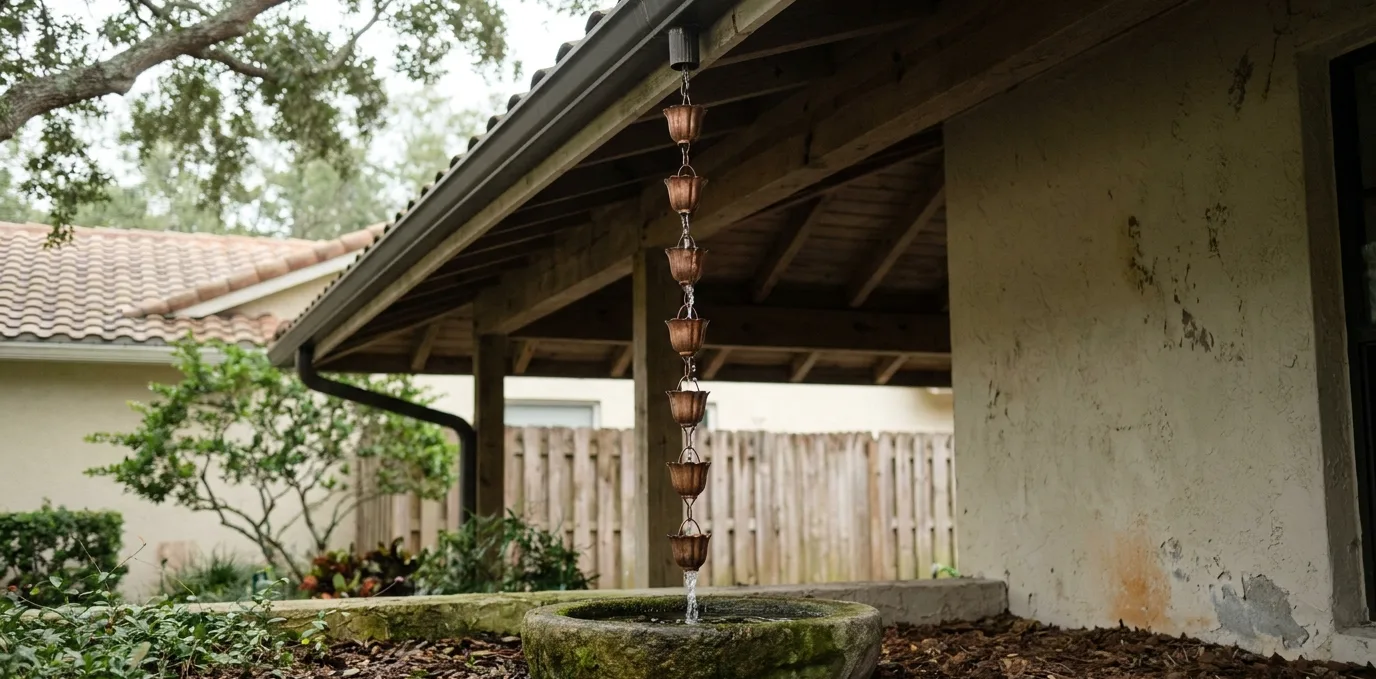
What a Rain Chain Actually Is
A rain chain is a decorative alternative to an enclosed downspout — a run of linked metal cups or links that water follows down from a corner of the gutter, in full view instead of hidden inside a pipe. It works with an open trough at that corner instead of a downspout outlet, so water leaves the gutter and travels down the chain by surface tension and gravity rather than through a closed tube.
Most of what we install in the Orlando area is copper, which develops a soft green patina over a year or two outdoors, or powder-coated aluminum that holds its original color longer without that patina. Either one handles our humidity and rain volume fine — the material choice is really about the look you want on that corner of the house, not durability.
When a Rain Chain Is the Right Call, and When It Is Not
A rain chain looks best and works best on a covered porch corner, an entry feature, or anywhere you actually want to watch water move during a storm. It is the wrong fit anywhere the volume of water coming off that section of roof is heavy, or anywhere there is no planned place for the water to land once it reaches the ground.
- Good candidates — porch corners, garden entries, a courtyard downspout replacement, any run collecting from a modest section of roof
- Needs a landing spot — a rain chain still needs a basin, a dry well, or a graded path away from the foundation; letting it just splash onto bare soil next to the house recreates the exact problem a downspout extension is meant to prevent
- Not ideal for — a corner collecting runoff from a large roof section during a heavy summer storm, where the volume is more than a chain can carry without splashing wide of any basin underneath it
We will walk the roofline with you and tell you honestly whether a given corner is a good rain chain candidate or whether that particular run needs to stay a closed downspout.
Orlando's High Water Table, and Why Water Cannot Just Be Turned Loose
Central Florida sits on a high water table, and through the wet season — roughly June into November — the ground around a lot of homes stays saturated for days after a storm has already passed. Downspout water that would soak into dry soil in October can have nowhere to go in August, because the soil around the foundation is already holding about as much water as it can.
That changes how we route drainage. A downspout extension that simply moves water ten feet from the foundation is not much help if that whole side yard is already waterlogged — the water just pools somewhere else close by, or works its way back toward the slab. For those yards, we look at buried extension lines that carry water further from the house, sometimes to a dry well or a graded low point on the property, or a French-drain-style trench that gives water a path to move laterally through gravel and perforated pipe instead of sitting on top of saturated clay or sand.
This is a different problem from a downspout simply dumping too close to the foundation, which is more about splash and erosion right at the wall. Here, the issue is that the ground itself does not have room to absorb what a normal Orlando downpour delivers, and the fix has to move water somewhere the soil can actually take it.
Grading and Basic Drainage Principles We Check
Before we recommend a fix, we look at how the ground actually moves water across your property, not just at the downspout outlet itself.
A lot of drainage complaints turn out to be a grading problem that predates the gutter system entirely — sod laid too flat during construction, mulch beds built up over years until they're higher than the slab they sit against, or a driveway that was poured with a slight tilt back toward the house instead of away from it. Fixing the downspout or adding a rain chain on top of a grading problem like that treats the symptom without touching the cause, so we'll flag it honestly when we see it, even if regrading isn't part of what we do ourselves.
- Slope away from the foundation — the first few feet of grade next to the house should fall away from the slab, not toward it
- Low points and where they drain to — every yard has a spot water naturally collects; the question is whether it is fifteen feet from your house or against the wall
- Existing hardscape — driveways, patios, and walkways can redirect water in ways that are not obvious until a storm shows you
- Neighboring runoff — on some lots, especially anywhere downhill from a neighbor, part of the standing water is not even coming from your own roof
Once we know where the water wants to go on its own, Orlando Gutter Crew designs the drainage — chain, buried line, dry well, or a combination of the three — to work with that instead of fighting it.
Frequently asked questions
Do rain chains handle heavy rain as well as a downspout?
For a moderate volume of water, yes, and the visual is worth it. During the heaviest part of an Orlando summer storm, a chain can splash more than a closed downspout would on that same corner, so we usually recommend them for smaller roof sections or covered areas rather than the corner catching your largest run.
Can a rain chain be added to my existing gutters, or do I need new gutters?
In most cases we can convert an existing downspout outlet to an open trough for a chain without touching the rest of your gutter system. It is a straightforward swap at that one corner.
What exactly is a dry well?
It is a gravel-filled pit buried below grade that collects downspout or drainage-line water and lets it soak into the surrounding soil gradually, instead of all at once at the surface. It gives water somewhere to go even when the ground nearby is already saturated.
How do you decide where to route drainage on a specific property?
We look at your actual grade, where water already pools after a storm, where a neighbor's runoff enters your lot, and how saturated the ground stays during the wet season. That combination tells us whether an extension, a dry well, or a French-drain-style line makes sense, and where it needs to end up.